
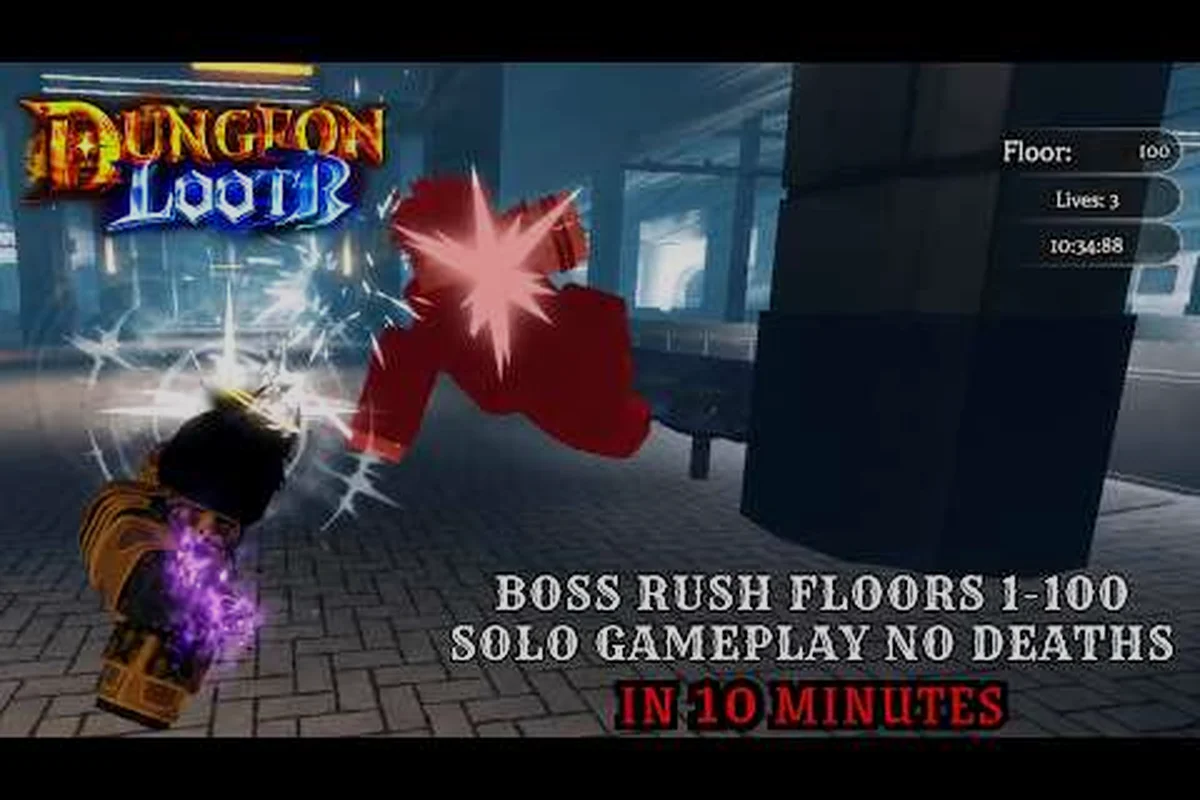
A solid dungeon lootr boss rush strategy separates players who clear all 100 floors from those who burn out around floor 40. Boss Rush throws 100 escalating multi-HP-bar boss fights at you in a single run, and community data shows a strong S-tier class can solo it in under 15 minutes when rotation, chest picks, and Blessing stacking all line up. This guide breaks down the class tier list, the 2-of-3 chest economy, the pacing window that keeps your HP bar healthy, and how to pivot when Challenge Dungeon mode drops you into something meaner. You will walk away with a repeatable dungeon lootr boss rush strategy you can run tonight.
Why Boss Rush Demands a Different Playbook
Boss Rush is not the same as grinding standard dungeons. The mode strips out the hallway trash mobs and chains boss fights back-to-back, which means your build has to scale against multi-bar enemies with limited downtime between pulls. According to the official Dungeon Lootr Roblox page, Boss Rush is one of two named high-difficulty modes alongside Challenge Dungeon, and the mode drops class items plus rare boss materials required for class evolution. That makes every clear matter for your long-term progression, not just your leaderboard time.
Core Boss Rush Rules Every Runner Should Know
The ruleset is intentionally short, but every line has cascading consequences for your dungeon lootr boss rush strategy: the 2-of-3 chest lockout means you must weigh immediate stat upgrades against saving a slot for a guaranteed class item on the final boss, the no-trash rule forces your build to burst a boss in under 15 seconds to maintain the sub-15-minute pace, and the solo-vs-coop split means your dungeon lootr boss drops allocation shifts based on lobby size — ignoring any single rule collapses the entire 100-floor tempo chain that separates a top-tier dungeon lootr boss rush strategy from a slow, potion-burned clear.
-
100 escalating floors, each a single boss fight with no trash between rooms
-
2-of-3 reward chests after every kill, with the third locked out
-
Class items and rare boss materials as the headline dungeon lootr boss drops
-
Solo or co-op, though community data suggests a top-tier solo class clears faster than mixed lobbies
-
Sub-15 minute pace is the mark of a tuned S-tier build
A boss rush 100-floor run only feels short when your class melts health bars in 8 to 12 seconds. When a floor drags past 25 seconds, you start losing the tempo that carries you into the final boss with potions still in the bank.
Top Class Picks for the 100-Floor Climb
Class choice is the single biggest lever in any dungeon lootr boss rush strategy. Community testing and official patch notes both point to a tight S-tier of awakened and EX-tier classes that outscale everything below them, because their damage kits front-load burst into the first multi-bar phase where most players eat the most chip damage. The official Roblox listing confirms there are 30+ unique classes to spin, but only a handful consistently clear the 100-floor mark under the 15-minute bar.
S-Tier Boss Rush Classes
These are the classes that anchor a serious dungeon lootr boss rush strategy, chosen because their raw output and survivability let players skip entire boss phases rather than playing them straight. In challenge dungeon runs where the final boss's enrage timer can delete a phase-3 attempt in under ten seconds, classes like Awakened Devil EX and Honored One simply out-DPS the scripted punishment windows, meaning you rarely have to learn the safe-stride timings, i-frame cancels, or add-management priorities that a slower team comp would be forced to master on every pull.
| Class | Style | Strength | Why It Works in Boss Rush |
|---|---|---|---|
| Awakened Devil EX | Melee burst | Highest sustained damage | Burns through multi-bar HP pools before retaliation windows open |
| Awakened Vergil | Hybrid melee/ranged | Excellent mobility | Strafes between boss telegraphs while keeping DPS uptime near 100% |
| Honored One | Ranged burst | Long-range zoning | Stays outside melee punish windows during the final boss's biggest swings |
| Cursed King | AoE melee | Strong cleave | Mops up boss add phases faster than single-target kits |
A-Tier and Situational Picks
A-tier classes can still clear Boss Rush, but they demand tighter execution and more chest-roll luck to keep pace. They are the right call when you have not unlocked an awakened class yet, or when you want to farm a specific boss drops table without burning your best build.
| Class | Strength | Weakness | Best Use |
|---|---|---|---|
| Anti Magic | High defense, anti-element shields | Lower DPS ceiling | Surviving floors 70-90 when boss damage spikes |
| Toji | Fast basic-attack chains | Squishy in late floors | Early rush until floor 30, then swap if available |
| Dante | Stylish combo chains | Long animation locks | Players still learning the 2-of-3 chest timing |
If you want a deeper walkthrough of how each class evolves and what materials you need to unlock the awakened forms, the Dungeon Lootr boss guide covers the unlock trees in detail, including the per-class Awakening Stone drop sources from Boss Rush floor milestones, the shard-to-token conversion rates that gate each tier, and the stat breakpoints (such as Anti Magic's +12% shield scaling or Dante's combo multiplier cap) where the awakened form genuinely outperforms its A-tier base, making it worth the grind before committing your A-tier pick to a full 100-floor run.
Reading the 2-of-3 Chest Economy
Every boss in Boss Rush ends with three reward chests, and you only get to open two. That choice is the second pillar of a working dungeon lootr boss rush strategy, because the third chest always contains something you cannot get from the other two. The community rule of thumb is simple: if you need a specific upgrade to survive the next 10 floors, ignore the third chest. If you are stable and chasing a long-term class item, gamble on it.
Reward Chest Pacing Across Floors
| Chest Color | Common Drop | Rare Drop | When to Pick It |
|---|---|---|---|
| Gold Chest | Coins, basic potions | Class unlock frags | Early floors when you need potions and forge fuel |
| Purple Chest | Stat gems, reforge stones | Mid-tier class items | Mid-run when you need damage upgrades |
| Rainbow Chest | Aspect Gems, Blessings | Awakened class materials, boss-exclusive loot | Late floors when survival is no longer the bottleneck |
The 2-of-3 Decision Tree
Before you even crack open the first chest, lock in your build identity — assess your current weapon tier, Blessing stack count, and Aspect Gem slots so the decision branches below actually mean something; a run leaning on Frost Aspect stacks values Blessings, while a glass-cannon knife build wants raw damage gems, and choosing wrong here can snowball into a failed boss rush at floor 60+ where you simply lack the scaling to keep up.
-
Floor 1 to 30: Always skip the rainbow chest unless it is an Aspect Gem, because early potions and reforge stones outweigh the gamble.
-
Floor 31 to 70: Open two of three with bias toward the chest that matches your weakest stat. A Blessing-heavy run wants stat gems, not raw damage.
-
Floor 71 to 100: Take the rainbow chest whenever it offers boss materials, because the final boss drops are what carry you to the 100-floor clear and unlock class evolutions for the next run.
This is also where the 100-floor pacing math gets interesting: across a full 100-floor clear, the 2-of-3 chest mechanic opens roughly 70 chests per run, and shifting your bias by just one floor band (e.g., treating floor 65 like floor 71) compounds into 4-6 extra boss materials before the final boss, which directly feeds into the boss rush damage-scaling breakpoint. The boss reward chests guide breaks down drop-rate math if you want to optimize specific runs, but the key takeaway is that chest sequencing from floor 31 onward should always be re-evaluated against your remaining Blessing stack count rather than locked in at run start.
Pacing and Rotations That Carry Floor 100
The difference between a 12-minute clear and a 20-minute wipefest is pacing. A clean dungeon lootr boss rush strategy front-loads speed, banks potions in the middle stretch, and only burns cooldowns defensively in the final 30 floors where boss damage actually spikes.
The Three-Phase Pacing Model
| Phase | Floors | Goal | Key Action |
|---|---|---|---|
| Sprint | 1 to 33 | Burn time, build lead | Skip every third chest, use burst cooldowns on every boss |
| Bank | 34 to 70 | Stockpile resources | Open defensive chests, save cooldowns for multi-phase fights |
| Survive | 71 to 100 | Trade speed for survival | Open every rainbow chest, treat potions as the win condition |
During the Sprint phase, your goal is to bank 4 to 5 minutes of buffer so the slower late floors do not break your sub-15 target. The Bank phase is where most runners leak time, because they keep opening damage chests when their real bottleneck is incoming boss damage. The Survive phase inverts the rotation: every chest should feed defense, healing, or boss drops, because the final boss can two-shot most A-tier classes if you walk in with a half-empty potion belt.
Counter Rotation Basics
A counter rotation is the looping sequence of skills you press between boss telegraphs, and the specific spell you open with should be matched to the boss's first wind-up animation in your dungeon lootr boss rush. For most S-tier classes, it looks like the four-phase opener-burst-strafe-punish rhythm below, but you swap the opener based on the boss's telegraph family: fire-phase bosses like Cinder Wraith want an Ice Shard opener, while the final boss drops only when you lead with a Piercing Sigil. Tracking this matchup is what separates sub-3-minute clears from the 4-to-5-minute plateaus most runners hit on floor 50+.
-
Opener burst during the boss's wind-up animation (0 to 1.5 seconds)
-
Strafing window while the boss is mid-swing (1.5 to 4 seconds)
-
Punish window during the boss's recovery (4 to 7 seconds)
-
Reset before the next phase bar (7 to 10 seconds)
That 10-second loop is what every dungeon lootr boss rush strategy has to internalize. If your opener is shorter than 1.5 seconds, you are not pressing enough buttons. If your punish window is shorter than 3 seconds, you need a faster class. Most runners who plateau around floor 50 are leaking 2 to 4 seconds per fight by ignoring the strafe window entirely.
Challenge Dungeon Mode and the Final Boss
Challenge Dungeon is the other end-game mode the official Roblox page calls out, and it shares a lot of DNA with Boss Rush but with higher stakes. If you want a mode-specific dungeon lootr challenge dungeon guide, the short version is: the mode is a curated gauntlet of the hardest bosses in the game, with stronger modifiers and rarer loot, and the final boss hits like a truck. Most players run Boss Rush first to farm materials, then move into Challenge Dungeon once their awakened class is fully kitted.
Drop Economy Comparison for Farming Routes
| Mode | Floors | Modifier Style | Best Use |
|---|---|---|---|
| Boss Rush | 100 fixed boss fights | Escalating boss HP and damage | Farming class items and practicing rotation timing |
| Challenge Dungeon | Variable, curated set | Boss-specific buffs and debuffs | Chasing rare boss drops and pushing awakened evolutions |
| Standard Dungeon | Procedural, with hallways | Modest scaling | Stockpiling coins and reforge stones between runs |
For a deeper breakdown of the mode, including how to enter it, the Challenge Dungeon guide at Dungeon Lootr maps out the unlock path and the first-time clear rewards. The guide also walks through the encounter-by-encounter modifier stack used in Challenge Dungeon, which differs sharply from Boss Rush's flat HP/damage scaling — for example, boss-specific debuffs like -30% dodge on Floor 47 or +50% projectile speed on Floor 62 force players to swap their standard Boss Rush gear loadout for higher resistance and shorter cooldown setups, making the two modes reward fundamentally different stat priorities.
The Final Boss and How to Not Wipe
The final boss on floor 100 of Boss Rush is a multi-phase encounter that punishes players who entered with empty potions, and the wipe-rate spikes sharply at the 25% enrage threshold because the boss gains a stacking damage-over-time aura that ticks for roughly 8% of max HP per second. Treat it as a three-stage fight where resource discipline between phases matters more than raw DPS: every potion and cooldown you burn in phase 1 is one you won't have for the 60%→25% window where the one-shot telegraph forces a strafing rotation and eats your healing budget. The players who consistently clear this encounter are the ones who walk into floor 100 with a full flask stack and cooldowns unspent, treating phases 1 and 2 as a controlled burn rather than a burst race.
-
Phase 1 (100% to 60% HP): Use your opener burst rotation. Save cooldowns for the phase transition.
-
Phase 2 (60% to 25% HP): The boss unlocks a one-shot telegraph. Strafing window becomes mandatory, not optional. Pop a potion the moment your HP drops below 50%.
-
Phase 3 (25% to 0% HP): Boss enrage. Burn everything. If you are still above half HP, you will clear; if you are below, the enrage will finish you.
The dungeon lootr final boss is where most 90% clears die. Players who hit phase 3 with cooldowns still on the bar and potions still stocked clear it consistently. Players who burned their cooldowns in phase 1 almost always wipe.
Dungeon Lootr Boss Drops and Why They Matter
Boss drops are the long-term payoff for any dungeon lootr boss rush strategy, and the community boss guides confirm that Boss Rush is one of the best farming sources for both class items and the rare boss materials required to evolve classes like Vergil into Awakened Vergil or Devil into Awakened Devil EX. You cannot pull those awakened forms from a Lucky Spin; you have to earn them through boss kills.
Drop Categories You Will See Most Often
| Drop Category | What It Is | Why You Want It |
|---|---|---|
| Class Items | Class-locked weapons and relics | Required to unlock or awaken a specific class |
| Boss Materials | Rare ingredients from named bosses | Fuel class evolution and reforge upgrades |
| Aspect Gems | Stat-stacking gems | Direct damage or defense boost, stacks with your class kit |
| Forge and Reforge Stones | Crafting currency | Used at the in-hub Forge to reroll and upgrade gear |
| Blessings | Run-long passive buffs | Stack across kills for compounding power in long runs |
A practical dungeon lootr boss rush strategy treats drops in two buckets: survival drops (potions, reforge stones, defensive Blessings) and progression drops (class items, boss materials, Aspect Gems). Sprint phase wants survival. Bank phase wants balance. Survive phase wants progression, because that is what carries over after the run ends.
Common Mistakes That Break Boss Rush Runs
Every mistake below actively inverts the dungeon lootr boss rush strategy pillars — opener burst, cooldown pacing, and strafe discipline — and even top-tier classes like the Samurai or Voidwalker lose their edge when runners treat the final boss phase as filler rather than a tight execution check, so treat each line as a forced checkpoint before re-engaging with the run.
-
Burning cooldowns in phase 1 of every boss, leaving nothing for the final boss
-
Opening rainbow chests early when potions and reforge stones would have saved a wipe
-
Ignoring strafe windows and face-tanking boss telegraphs through floor 80
-
Running an A-tier class into the final boss without checking potion count first
-
Pacing the first 30 floors slowly because the early bosses feel easy
If you are still hitting walls around floor 50, the most likely culprit is opener burst, not class choice. Most runners who plateau there are losing 2 to 4 seconds per fight by skipping the wind-up punish window entirely.
Putting It All Together
A repeatable dungeon lootr boss rush strategy has four moving parts that all need to work in the same run: class pick, chest economy, pacing, and counter rotation. Pick an S-tier awakened class, front-load burst in the first 33 floors, swap to defensive chests from floor 34 to 70, and treat the final 30 floors as a survival problem rather than a speed problem. Master the 10-second rotation loop, and the final boss becomes a clean three-phase clear rather than a coin-flip. Boss Rush is one of the cleanest ways to farm the materials you need for class evolution, and a tuned strategy will hand you sub-15-minute clears with potions to spare.
Frequently Asked Questions
What is the best class for a dungeon lootr boss rush strategy?
Community data and the developer's own research both point to Awakened Devil EX as the top pick, because its melee burst kit melts multi-bar HP pools before the boss's retaliation window opens. Awakened Vergil and Honored One are close second picks if you prefer mobility or ranged zoning.
How long does a full 100-floor Boss Rush clear take?
A top-tier solo class with a tuned rotation can clear all 100 floors in under 15 minutes. Most A-tier classes and unoptimized runs land between 18 and 25 minutes, and the final boss on floor 100 is where the largest time gap between builds shows up.
How do I unlock Boss Rush and Challenge Dungeon in Dungeon Lootr?
Both modes unlock through the main hub once your player level is high enough and you have cleared the prerequisite dungeons. The Boss Rush unlock walkthrough covers the exact unlock steps and the first-time clear rewards you should expect.
What are the best dungeon lootr boss drops to farm?
Class items and rare boss materials are the headline drops, because they unlock awakened class evolutions like Awakened Devil EX and Awakened Vergil. Aspect Gems and Blessings are the next-best targets for raw power, while reforge stones are best stockpiled between runs at the in-hub Forge.
Can I run Boss Rush solo, or is co-op better?
Boss Rush is fully solo-able, and community data suggests solo runs with a top-tier class actually clear faster than mixed lobbies because there is no loot contention after each kill. Co-op helps on Challenge Dungeon, where coordinated burst lets you skip dangerous boss phases entirely.